

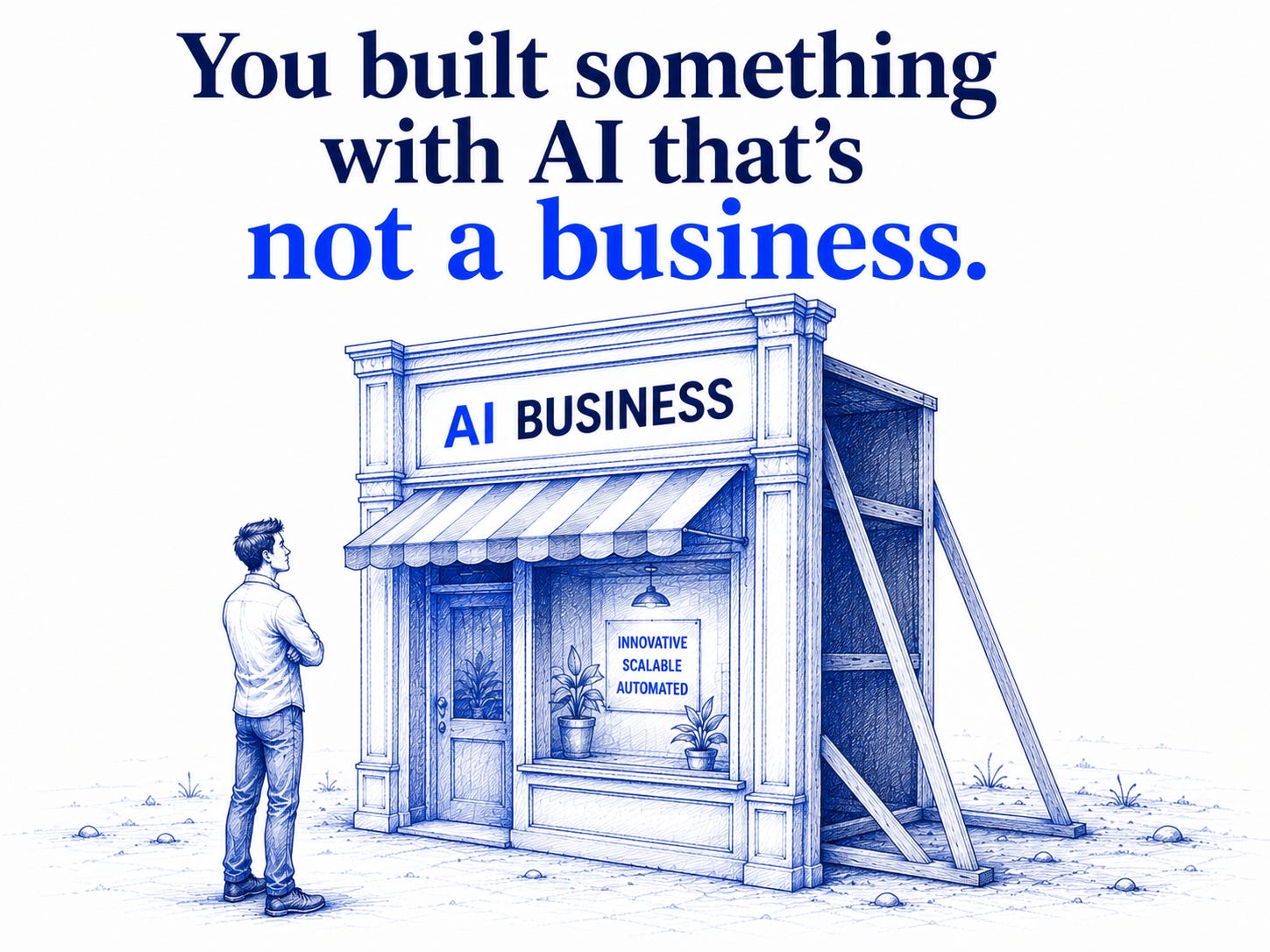
I keep watching the same thing happen, and it’s starting to worry me.
Someone builds a tool in a weekend. AI did most of it. Clean interface, works on the first try, and they post the screenshot like they crossed a finish line. Founder now. Company started. And I understand the feeling, because for years the build was the wall. It was the part that took money you didn’t have and a team you couldn’t hire and six months you couldn’t spare. So if the wall is gone, you must be most of the way there.
You’re not. You’re at the start. The wall was never the business. It was just standing in front of it, big enough to hide everything behind it. AI knocked it down, and now you can see the whole field, and the field is exactly as hard as it always was. Probably harder, because everyone else is standing in it too.
Here’s what I actually believe after building five companies. AI made building a product almost free, and it made building a business harder, because it flooded every market with products and changed nothing about how you get a stranger to care. The thing it can’t do, the part where you reach people and earn their trust and give them a reason to choose you, that part didn’t get easier. It became the entire game.
The cheap part and the expensive part
There’s a product and there’s a business, and people keep using the words like they mean the same thing.
The product is the thing. The app, the offer, the service. AI is incredible at helping you make the thing. A person with no technical background can now go from an idea to something real and working in a few days. Not a mockup. A functional product someone could actually use.
The business is everything around the thing. Who needs it. How they find out it exists. Why they pick you over the ten people who shipped the same idea last Tuesday. How it gets paid for. Who answers when it breaks. What keeps it running on a day you’re not there.
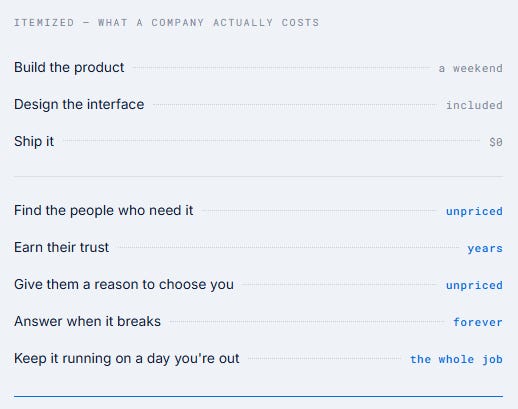
You got the first one handed to you. You got nothing on the second. And the second one was always the actual work. You just couldn’t see that before, because the building was hard enough to keep the truth politely hidden. Now the building is easy, so the truth is sitting out in the open. You can have a brilliant idea. You can build it perfectly. And if you can’t get it in front of anyone, you don’t have a business. You have a really good product with no path to anyone’s wallet.
That’s not a motivational point. It’s a math point. And the math has been sitting in plain sight for years, long before anyone was building anything in a weekend.
This was killing companies long before AI
Here’s the part that should stop you. The thing that kills most companies has nothing to do with how good the product is. We have the receipts on this, and they go back years.
CB Insights pulled apart 431 companies that died and looked for the real cause. The number one answer wasn’t bad code or a weak product. It was that they built something the market didn’t want, or couldn’t be reached with. Poor product-market fit, in 43 percent of them.
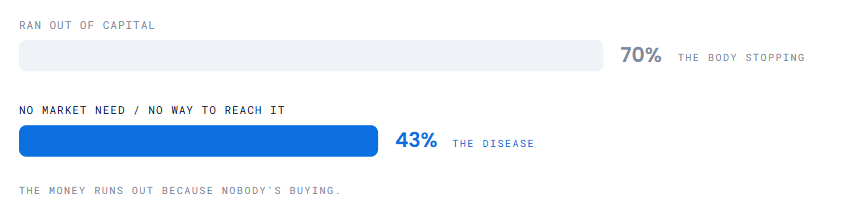
“Ran out of money” shows up on 70 percent of the post-mortems, but that’s the body finally stopping, not the disease. The money runs out because nobody’s buying. Nobody’s buying because the thing got built before anyone confirmed they wanted it, or it got built fine and never got in front of the right people.
Read that again with AI in mind. The number one killer of companies, for years, before any of this, was building something nobody needed or nobody could find. That was the wound. So what did AI actually change about it? It made that exact mistake faster, cheaper, and easier to make in bulk. It didn’t cure the disease. It handed the disease a printing press.
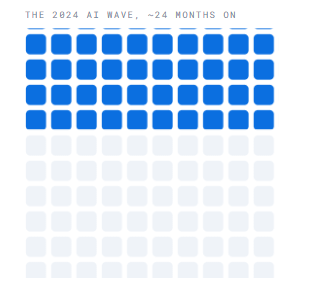
You can see it already. Of the giant wave of AI startups that launched in 2024, a huge share were dead inside two years. Most of those founders weren't fools. They built working products. Some had paying customers. They died anyway, because a thin layer on top of a model, with no audience and no relationships and no reason to be chosen, is not a company. It's a feature in a company costume. The report I trust most on this said it without flinching: capital isn't the bottleneck anymore, distribution is, and the founders still saying "we'll figure out how to reach people later" are this year's casualties.
Building was never your bottleneck. It was just the loudest problem in the room.
AI walked in and quieted the loud one. Now you can finally hear the quiet one that was doing the actual killing.
The success story everyone points to proves the opposite
Now, someone always pushes back here, and they push back with the same example every time. So let me take it head on, because it actually makes my case better than I could.
I’m not going to pretend AI changed nothing. It changed who gets to compete, and that’s real and it matters. People love to bring up Base44. One guy. He didn’t train a model, he wired existing ones into a product, grew it past 250,000 users with almost no marketing, and sold it to Wix in about six months for roughly 80 million dollars, as the only shareholder. One person. That’s the dream everyone’s chasing, and it actually happened, so doesn’t that blow up everything I just said?
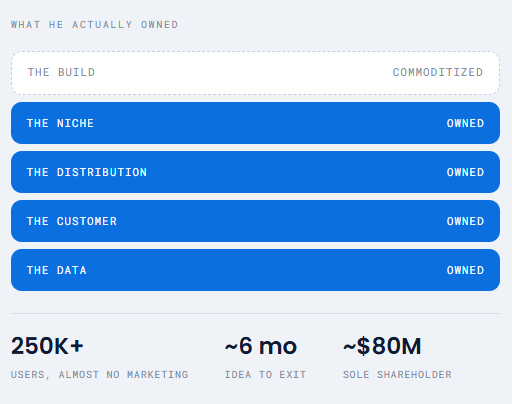
Look at what he owned. The niche. The distribution. The customer. The data. The build, the part AI helped with, was the cheap part of the whole story. He won on every single thing AI didn’t give him. The one-person miracle everybody cites didn’t win because he could build fast. He won because he understood a specific group of people, got the thing in front of them, and held the relationship with them directly.
That’s not the exception to the rule. That’s the rule, standing in the middle of the best-case scenario. The tool got commoditized. The relationship didn’t. So no, you don’t need to outspend anyone or hire an army to build anymore, and that’s a genuine gift. But the gift is time and capability. It is not a business. What you do with the time you got back is still the whole thing, and almost everyone is spending it building more product instead of building the one thing that carries a product to revenue.
The work just moved to the part AI can’t touch
So if AI didn’t take the hard part away, where did the hard part go? It moved. It moved to the exact place a model can’t follow you, and once you see the line, you can’t unsee it.
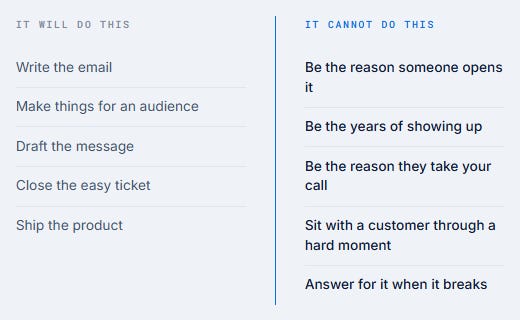
AI can’t make someone trust you. It’ll write the email. It can’t be the reason the person opens it. It can’t hand you an audience either. It can help you make things for one, but it can’t be the years of showing up that make a stranger care what you say. It can’t build your network. It’ll draft the message, but the reason that person takes your call is yours to earn the slow way or not at all. It can’t sit with a customer through a hard moment. It’ll close the easy ticket and go quiet the second real money or real reputation is on the line. And it can’t be accountable. When something breaks, a person has to answer for it, and that person is the business. The model is just a tool the business happens to use.
This is the part that flips the whole thing. When building was hard, building was an edge. You could win just by being the one who managed to ship. That edge is gone. Everyone ships now. So the only ground left to win on is the ground AI can’t stand on, and all of it is slow, all of it is human, and none of it can be generated over a weekend. The trust. The audience. The systems. The people.
The shiny part went free. Which is exactly why the unshiny part just became the most valuable thing you own.
So go build the business
That’s a nice thing to say and a harder thing to do. If I’m going to tell you the building was the easy part, I owe you the hard part in plain terms. So here’s how I’d actually go after it, and the order matters more than any single move.
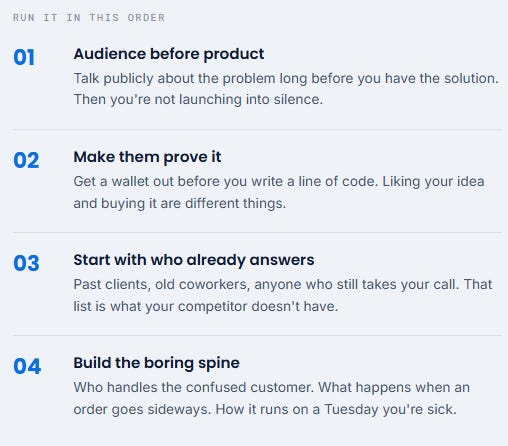
Build the audience before you build the product. This feels backward and it’s the most important thing I’ll say. Most people build the thing and then go hunting for someone to sell it to, which is the exact path into that 43 percent. Flip it. Start talking publicly about the problem long before you have the solution. Get in front of the people who have the pain while it costs you nothing. Then you’re not launching into silence, you’re launching to people who already know you and already have the problem, and the product becomes the easy part. Which, thanks to AI, it now is.
Once you have people listening, make them prove they actually want it. Get a wallet out before you write a line of code. Liking your idea and buying your idea are two completely different things, and the gap between them has buried more companies than any competitor. Pre-sell. Ask for money on the thing that doesn’t exist yet. It’s uncomfortable, and the discomfort is the whole point, because it’s the only honest test of whether you have a business or just a circle of people being nice to you. If not one person will pay before you build, building it won’t fix that. It’ll just cost you three months to learn the same lesson the slow way.
And you don’t have to find those first people from scratch, because you already know more of them than you think. You believe you’re starting from zero. You’re not. Every past client, old coworker, and person in your world who still takes your call is distribution you already own. That list is the one thing the person who shipped your exact product last week doesn’t have. They have your tools. They don’t have your relationships. Distribution isn’t a channel you go rent later, it starts as the people who already pick up the phone.
Get all that right and you’ll have demand. Then you need something to hold it, which means building the boring spine. The people and the systems behind the product. Who handles the confused customer. What happens when an order goes sideways. How it runs on a Tuesday when you’re sick. None of that is fun and none of it gets done by a clever prompt, and it’s the exact difference between a business and a demo that breaks the first time real life touches it.
Notice what AI did and didn’t do across all four of those. It didn’t do any of them. What it did was buy back the time so you could. That’s where it actually belongs in the story. Not as the business, as the tool that frees you up to go do the human work the business is actually made of. Every hour it saves you is real. Just don’t spend that hour making more product nobody asked for, which is the trap almost everyone falls into. Spend it on the customer, the audience, the relationships, the systems. Use the speed to go exactly where the machine can’t follow you.
What doesn’t change
Strip all of it back and you land on something simple. AI made building a product nearly free, and that’s not small. It’s one of the biggest shifts any of us will see in our working lives. But it didn’t touch the fundamentals, and the fundamentals are the business.
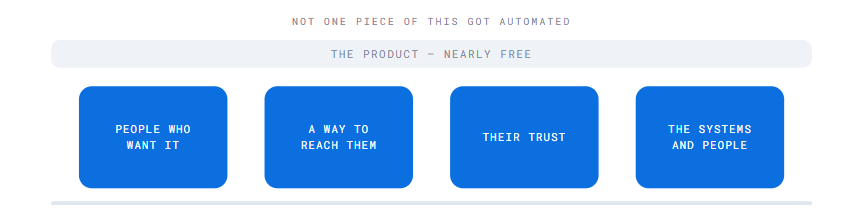
You still need people who want the thing. You still need a way to reach them. You still need their trust, and the systems, and the people to hold it all up. Not one piece of that got automated. All of it got more important, because it’s the only part left that’s actually hard.
I build with AI every day, so this isn’t me being precious about the old way. It’s the opposite. The more I lean on these tools, the more certain I am of the thing underneath them: the relationships it takes to build a business matter more now than they ever have. Not in spite of AI. Because of it.
Everyone can build now. Almost nobody can get the thing into the right hands. Pick the second one. That was always the business.
You've got the build handled.
So what are you actually doing this week to find the people you built it for?
Absolutely, AI is shifting the advantage from building faster to understanding customers deeper, because trust, distribution, and demand creation remain the true business differentiators.
This is exactly why I wrote recently that AI has made building cheap, not demand.
We’re entering a world where almost anyone can make something. Getting another human to care is still the hard bit.
We’re heading towards a shortage of attention. That’s a much harder problem to solve.
Build it and they still won’t come 🧱 https://millennialmasters.net/p/build-it-and-they-still-wont-come
The irony is AI has made founders much more productive, but it hasn’t created a single new customer.